
TL;DR: Homeowners insurance typically covers two things related to a slab leak: the resulting water damage to floors, walls, and belongings, and the cost to break through concrete to reach the pipe. It does not cover the failed pipe itself, which is considered a maintenance item. Every policy is different, so read your declarations page and call your adjuster before assuming anything is covered or excluded.
You noticed a warm spot on your tile floor, your water bill jumped $80 last month, and a plumber just confirmed you have a slab leak under your foundation. Now you’re staring at a repair estimate and wondering whether your homeowners insurance will help. The answer is: probably yes, but not for everything, and the details matter. This guide walks through how the standard coverage split works, what adjusters look for, how to document a claim, and what the repair itself will cost in Bakersfield.
Does homeowners insurance cover slab leaks?
Most standard homeowners policies cover sudden and accidental water damage from a slab leak, plus the cost to access the broken pipe, but they do not pay to replace the pipe that failed. This split is sometimes called “access and resulting damage” coverage. The logic: your policy insures against damage to your home, not against the gradual wear of your plumbing. The Insurance Information Institute describes this as a standard distinction in HO-3 policies, which cover sudden and accidental discharge but exclude maintenance-related deterioration.
In practice, that means:
- Covered (commonly): Hardwood floors buckled by escaping water, drywall soaked by moisture wicking up through the slab, personal property damaged by a flood event, and the concrete cutting or jackhammering required to reach the pipe.
- Not covered (commonly): The copper or galvanized pipe that corroded and failed, the labor to repair or reroute that pipe, and any damage the adjuster determines resulted from a slow, long-running leak you should have caught sooner.
The word “commonly” is doing real work in those sentences. Read your own policy. The exclusions section is where claims get denied.
Why Bakersfield homes are especially prone to slab leaks
Nearly every home in Bakersfield sits on a slab-on-grade foundation. There is no basement, no crawlspace, and no easy access to the supply lines and drain pipes embedded in or below that concrete. When a pipe fails, the only way to reach it is to go through the floor.
Bakersfield also has some of the hardest municipal water in California. High mineral content accelerates scale buildup inside copper pipes, thinning the walls over time and creating pinhole leaks. Pre-1970 homes in neighborhoods like Oleander, Westchester, and East Bakersfield often still carry original copper or galvanized supply lines, some of which are now 50-plus years old. That combination of hard water, aging pipe, and slab construction makes slab leaks one of the most common calls in this market.
If you have not yet confirmed you have a slab leak but something feels off, our post on 7 Warning Signs of a Slab Leak covers the symptoms in detail before you get to the insurance question.
What does a slab leak repair actually cost?
Slab leak repair in Bakersfield typically runs between $2,000 and $6,000 for a straightforward single-point repair, depending on where the leak is located, how thick the slab is, and which repair method makes sense. Here is how the cost breaks down:
Leak detection: A licensed plumber uses acoustic listening equipment or electronic amplification to pinpoint the leak without opening the floor. Expect $300 to $600 for professional detection. This step is important for insurance purposes too, because the detection report documents the leak’s location and likely cause.
Concrete access (jackhammering): Cutting through a residential slab typically costs $500 to $1,500 depending on the size of the opening needed. This is the portion many policies will reimburse as an “access” cost.
Pipe repair or reroute: A direct repair at the leak point runs $400 to $1,200 for parts and labor. If the pipe is too corroded to repair cleanly, or if the leak is in a location that makes direct access impractical, a plumber may recommend rerouting the line through the walls or attic instead, which avoids the slab entirely. Rerouting costs more upfront but eliminates future access problems.
Concrete patching: Closing the opening costs $300 to $800. Floor restoration (tile matching, hardwood refinishing) is separate and varies widely.
If water spread beyond the pipe before the leak was caught, drying out a soaked subfloor and slab is a separate scope of work. That falls under water damage restoration, not plumbing repair. If you are dealing with water that has already spread, ProRestoration Services, our sister company, handles the drying and structural rebuild after the pipe is fixed.
How to prove a slab leak to your insurance company
An insurance adjuster will want documentation that the leak was sudden and accidental, not the result of long-term neglect. Here is what strengthens a claim:
-
Get a written detection report. Before any concrete is opened, have a licensed plumber perform electronic or acoustic leak detection and provide a written report with the location, suspected cause, and their professional assessment. This is your primary piece of evidence.
-
Photograph everything before any work starts. Wet flooring, moisture on baseboards, efflorescence on the slab surface, any visible damage. Date-stamp the photos.
-
Document your water bills. A sudden spike in water consumption is evidence of a sudden leak, not a slow one. Pull 12 months of billing history from your water provider.
-
Call your adjuster before you open the floor. Most policies require you to notify the insurer and allow an inspection before repairs begin. Opening the slab without authorization can give the carrier grounds to deny the access portion of the claim.
-
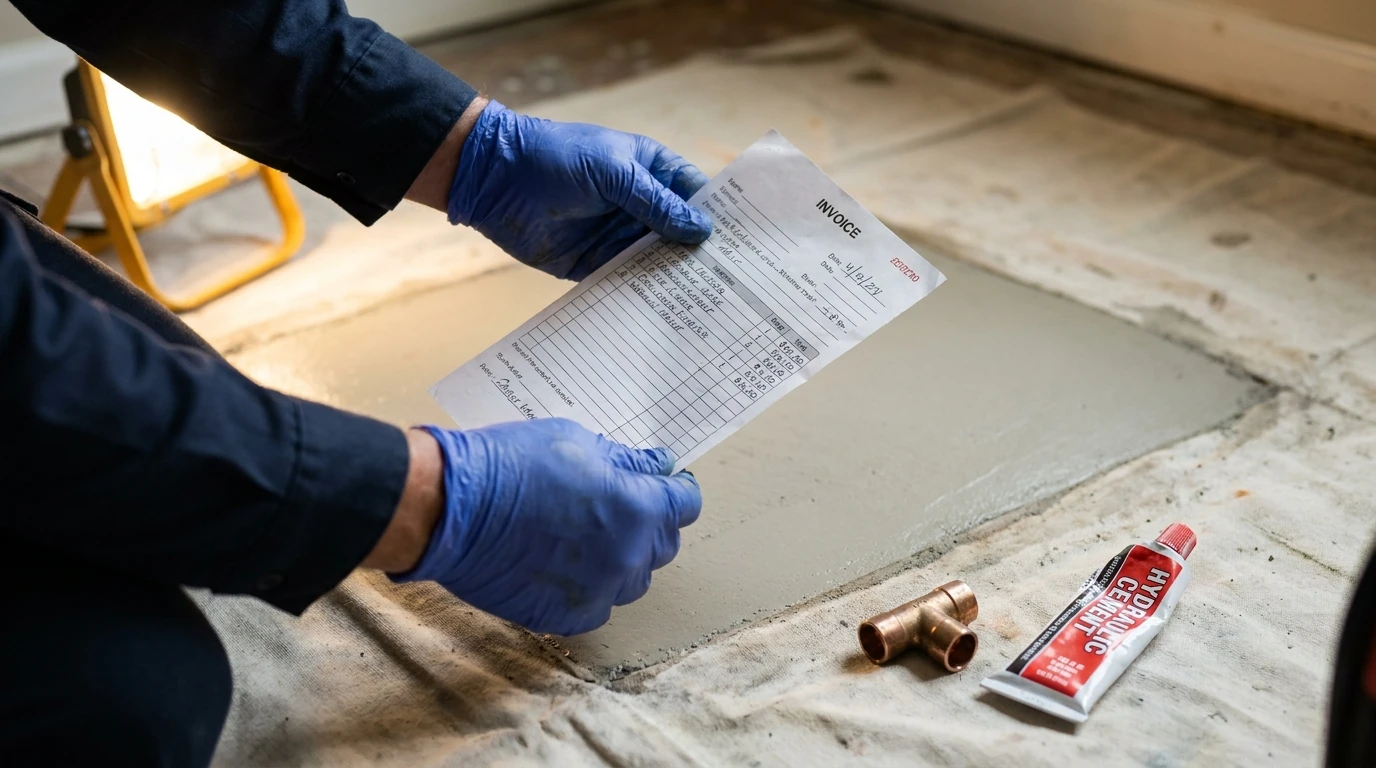
Keep all receipts and invoices. Detection, access, repair, and any emergency water extraction. Itemized invoices that separate these costs make the adjuster’s job easier and reduce the chance of a dispute.
If your claim is denied, the most common reasons are: the adjuster determined the leak was slow and long-running (gradual damage exclusion), the policy has a specific slab leak exclusion, or the documentation was insufficient. A public adjuster can help you contest a denial, though that is a separate conversation with its own costs.
What if insurance doesn’t cover the pipe repair?
Even when coverage applies to the access and resulting damage, you are still paying out of pocket for the pipe repair itself. That is typically the $400 to $1,200 range mentioned above. For older homes with deteriorating plumbing throughout, it is worth asking your plumber whether a whole-house repipe makes more sense than a point repair.
A repipe replaces all the supply lines at once, usually with PEX-A or copper, and eliminates the risk of future slab leaks from the same aging pipe stock. It costs more upfront, roughly $8,000 to $15,000 for a typical Bakersfield home, but it ends the cycle of repeated access repairs and the insurance headaches that come with them. You can review our repiping service page for more on what that process involves.
For homes where the leak is isolated and the rest of the plumbing is in reasonable shape, a direct repair or reroute is the right call. The key is getting an honest assessment from a plumber who will tell you which option actually fits your situation.
What to do next
If you suspect a slab leak, the sequence matters. Stop the water if you can (shut off the main), document what you see, call your insurance company to open a claim, and schedule professional leak detection before any concrete is touched. Detection first protects your claim and prevents unnecessary demolition.
All Pro Plumbing Heating and Air provides electronic and acoustic leak detection and handles slab leak repair across Bakersfield and surrounding communities. If you are ready to get a written detection report or want a repair estimate, call (661) 863-9242 or visit our slab leak repair service page to schedule.
About All Pro Plumbing Heating and Air
All Pro Plumbing Heating and Air is a licensed plumbing and HVAC contractor serving Bakersfield, CA and the surrounding Kern County area (license #960566). Their technicians handle leak detection, slab leak repair, repiping, water heaters, drains, gas lines, heating, and air conditioning, with 24/7 availability for emergencies. All Pro serves residential and light-commercial customers across Bakersfield, Oildale, Rosedale, Shafter, Delano, Taft, and Tehachapi.