TL;DR: A plumber charges roughly $95–$250 to snake a single-fixture drain, $200–$400 for a branch line, and $300–$600 or more to clear a main sewer line. Camera inspections add $150–$350. Hydro jetting runs $350–$850 depending on line length and condition. What you actually pay depends on where the clog is, how bad it is, and whether roots or pipe damage are involved. A written quote before any work starts is the only number that matters.
Your kitchen sink is draining like cold syrup. Or your shower is backing up every morning. Or, worst case, sewage is creeping up your floor drain. Before you call anyone, it helps to know what you’re likely paying and why, so you’re not guessing when a plumber gives you a number.
Drain cleaning isn’t one price. It’s a range that depends on which drain, what’s causing the blockage, and what method clears it. Here’s how those numbers break down.
How much does it cost to unclog a single fixture?
Snaking a single fixture, a bathroom sink, tub, shower, or toilet, typically costs $95–$250 in the Bakersfield area. That covers a plumber running a hand or drum auger through the trap and down the branch line until it hits the blockage and breaks it up or retrieves it.
Most single-fixture clogs are straightforward: hair and soap in a tub drain, a partial grease buildup in a kitchen P-trap, or a foreign object in a toilet. A standard cable machine handles these in 20–45 minutes. If the clog clears completely on the first pass and the drain flows freely, you’re at the lower end of that range.
The price climbs if the plumber needs to pull a toilet to access the drain, if the blockage is deeper than the branch line, or if the drain doesn’t fully clear and a second method is needed. Always ask whether the quoted price is for the snake attempt or for the drain to actually run clear, those aren’t always the same thing.
How much does it cost to clear a branch line or main sewer line?
Branch lines, the 2” to 3” pipes that connect multiple fixtures to the main stack, run $200–$400 to clear. Main sewer lines, the 4” pipe running from your house to the city sewer, typically cost $300–$600 to snake, and more if roots are involved.
Main line clogs are a different job. The plumber accesses a cleanout (usually near the foundation or in the yard), runs a larger cable machine with a cutting head, and works through the full length of the lateral. The job takes longer, the equipment is heavier, and the mess potential is higher, all of which factor into the price.
In older Bakersfield neighborhoods like Oleander, Westchester, and East Bakersfield, the mature tree canopy is beautiful and the sewer laterals are not. Ficus, pepper, and elm roots find hairline cracks in aging cast-iron or clay pipe and grow into them over years. A cable machine can cut through a root mass and restore flow, but it doesn’t fix the crack the roots entered through. If your main line clogs repeatedly, say, every 6 to 18 months, that’s the sewer telling you it needs more than a snake. See the section below on when snaking isn’t enough.
What does a camera inspection cost, and do I need one?
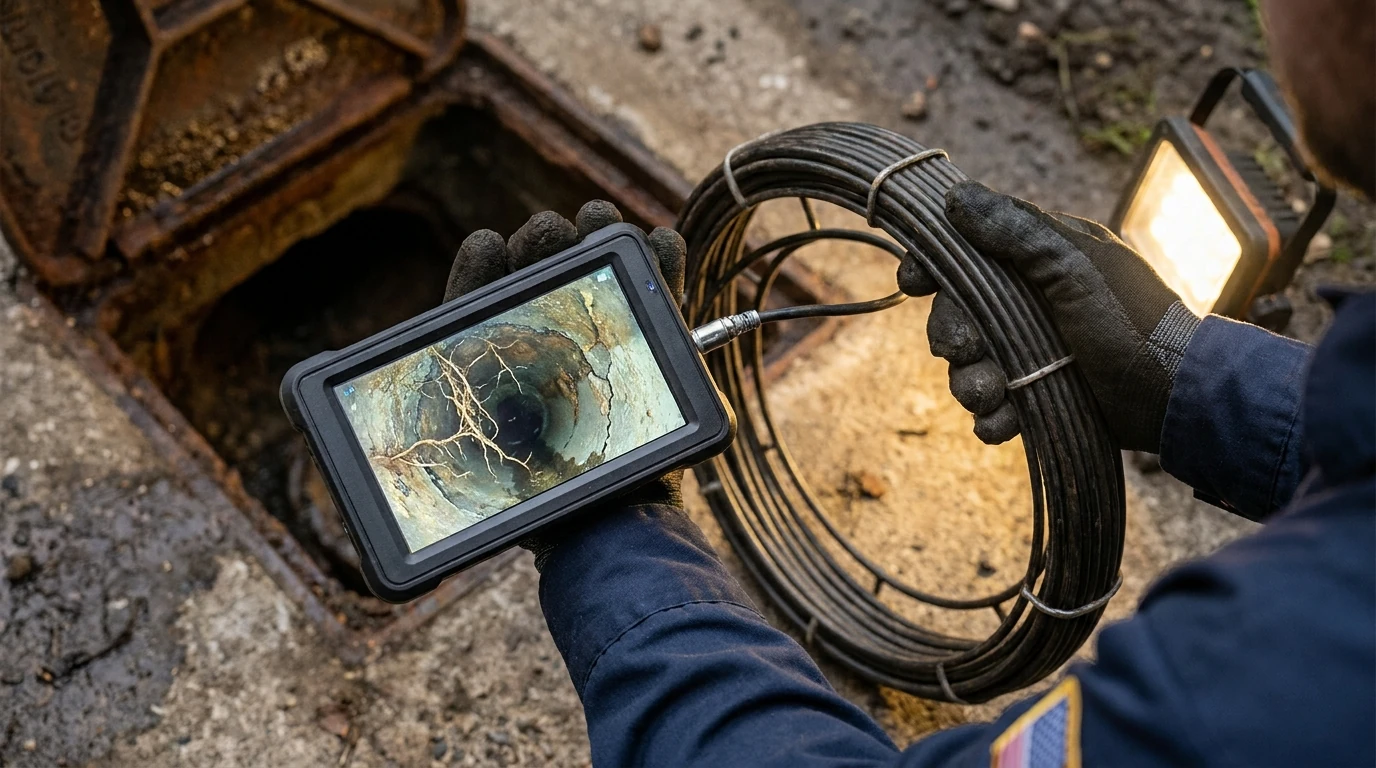
A sewer camera inspection typically costs $150–$350 as a standalone service. Many plumbers include it in the diagnostic visit or discount it when combined with a cleaning.
A camera is a flexible fiber-optic line with a transmitter head that sends live video to a monitor. The plumber feeds it through the cleanout and watches in real time what’s inside the pipe: grease coating, root intrusion, a belly (a low spot where solids collect), offset joints, or a collapsed section. The transmitter also lets them pinpoint the problem’s location on the surface above, useful if excavation is ever needed.
You need a camera inspection when:
- A main line clog comes back within a year of being cleared
- Sewage is backing up into multiple fixtures at once
- You’re buying a home built before 1980 (cast-iron and Orangeburg pipe are common in pre-1970 Bakersfield construction)
- A plumber clears the line but can’t tell you why it clogged
A camera inspection turns a guess into a diagnosis. Without it, you’re paying to treat symptoms.
How much does hydro jetting cost?
Hydro jetting costs $350–$850 for most residential jobs, with the range driven by line length, pipe condition, and how much buildup needs to be removed.
A hydro jetter pushes water at 3,000–4,000 PSI through a specialized nozzle that blasts forward and sprays backward simultaneously, scouring the pipe walls as it moves. It removes grease, scale, and root debris that a cable machine leaves behind. For a grease-coated kitchen drain or a root-intruded lateral that keeps coming back, hydro jetting is the more complete solution.
One important note: hydro jetting should always follow a camera inspection, not replace it. Blasting water into a pipe with a crack or a belly can make things worse. A camera tells the plumber whether the pipe can handle the pressure. For a deeper look at how these two methods compare, see our post on hydro jetting vs snaking, that post covers the method comparison; this one covers what each costs.
For lines with significant root intrusion, some plumbers use a root-cutting head on the jetter rather than a standard nozzle. This adds time and sometimes cost, but it’s more thorough than a cable cutter alone.
When does a repeat drain clog become a sewer line conversation?
A drain that clogs once is a maintenance issue. A drain that clogs every few months is a structural one.
If your main line has been snaked two or more times in the past two years, the pipe itself is likely the problem, not what’s going into it. Root intrusion through cracked joints, a collapsed section, or a severe belly won’t be fixed by any cleaning method. At that point, the conversation shifts to sewer line repair or replacement.
Trenchless options, pipe lining (CIPP) and pipe bursting, can often rehabilitate or replace a lateral without digging up your yard. Costs vary significantly by pipe length and condition, but a trenchless repair on a residential lateral typically runs $3,000–$8,000, compared to $5,000–$12,000 or more for open-cut excavation. A camera inspection is the starting point for any of those conversations.
The EPA’s SepticSmart resources offer useful background on how sewer and septic laterals function and what homeowners can do to extend their life, including what not to flush.
What should a written drain cleaning quote include?
A fair drain cleaning quote should specify the access point (which cleanout or fixture), the method (snake, hydro jet, camera), whether the camera inspection is included or priced separately, and what happens if the line doesn’t clear or if the camera reveals a bigger problem.
Watch for quotes that are vague about scope. “Clear the drain” means different things depending on whether the plumber is quoting a single fixture snake or a full main-line cleaning with camera documentation. Ask specifically: what does the price include, what triggers an additional charge, and will you get a written scope before any work starts?
For a broader look at how plumber pricing works by the hour vs flat rate, see how much does a plumber cost per hour in Bakersfield.
If you’re dealing with a slow drain, a recurring main-line backup, or you want a camera inspection before buying an older Bakersfield home, All Pro Plumbing Heating and Air handles drain cleaning and sewer diagnostics across the area, including drain cleaning service in Bakersfield. Call (661) 863-9242 to schedule, or request a written quote for the specific job you’re facing.
About All Pro Plumbing Heating and Air
All Pro Plumbing Heating and Air is a licensed plumbing and HVAC contractor serving Bakersfield, CA and surrounding communities (license #960566). Their technicians handle drain cleaning, sewer line diagnostics, water heaters, gas lines, heating, and air conditioning across Kern County. Available 24/7 for emergencies and scheduled service calls throughout Bakersfield, Oildale, Rosedale, Shafter, Delano, Taft, and Tehachapi.