
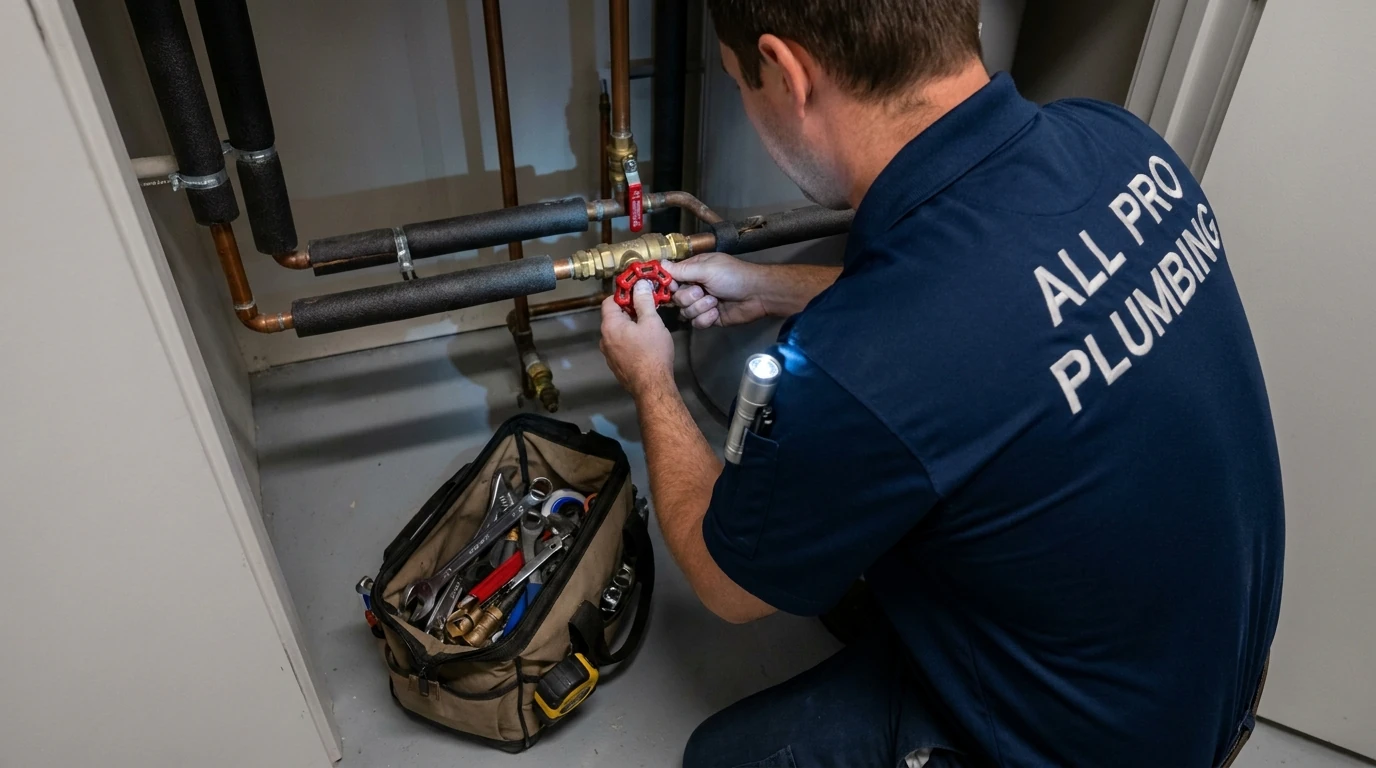
TL;DR: An emergency plumber call typically costs $150-$400 just to get a technician to your door after hours, on top of the actual repair. The total bill breaks into four layers: a call-out or trip fee, an after-hours rate multiplier, diagnostic time, and the repair itself. Knowing how each layer works lets you ask the right questions before you approve any work, and it helps you avoid the surprise at the bottom of the invoice.
It is 2 a.m. and water is running somewhere it should not be. You have already shut off the main, the floor is wet, and now you are staring at your phone wondering what this is going to cost. The honest answer is: it depends on four separate charges that most plumbers bundle together on one invoice. This post breaks each one apart so you know what you are agreeing to before the truck rolls.
Before anything else: if you have not shut off the water yet, do that first. Your main shutoff is usually near the water meter, at the front of the house, or in a utility closet. Turn it clockwise until it stops. For a detailed walkthrough of those first ten minutes, see our post Pipe Burst? What To Do in the First 10 Minutes.
What is an emergency plumber call-out fee?
A call-out fee (also called a trip fee or dispatch fee) is a flat charge just for sending a technician to your address, separate from any labor or parts. Most plumbers charge between $100 and $300 for an after-hours call-out, though the range can stretch higher in markets with fewer available contractors or during holidays. This fee covers the cost of pulling a technician from home or off another job, fueling the truck, and getting to your door, regardless of how long the repair takes.
Some companies roll the call-out fee into the first hour of labor. Others list it as a separate line item. Either way, ask for it explicitly when you call: “What is your call-out fee for tonight, and is it separate from your hourly rate?” A company that cannot answer that question clearly before dispatch is a company worth calling twice.
A few plumbers waive the call-out fee if you proceed with the repair. That is worth asking about too, but do not assume it.
How do after-hours, weekend, and holiday rates work?
After-hours rates are a multiplier applied to the standard hourly labor rate, not a separate fee on top of the call-out charge. A plumber who charges $120 per hour during business hours might charge $180-$240 per hour between 10 p.m. and 6 a.m., on weekends, or on federal holidays. That is a 1.5x to 2x multiplier, and it is standard across the trade.
The specific thresholds vary by company. Some define after-hours as anything after 5 p.m. Others do not add a premium until midnight. Weekend rates may be flat (one multiplier all day Saturday and Sunday) or tiered (Saturday daytime at 1.25x, Sunday and holidays at 1.5x or higher). Ask the dispatcher to state the rate and the time window before you confirm the call.
For a full breakdown of what plumbers charge during normal business hours, see our post How Much Does a Plumber Cost Per Hour in Bakersfield? (2026 Price Ranges).
What does the full emergency plumber bill actually look like?
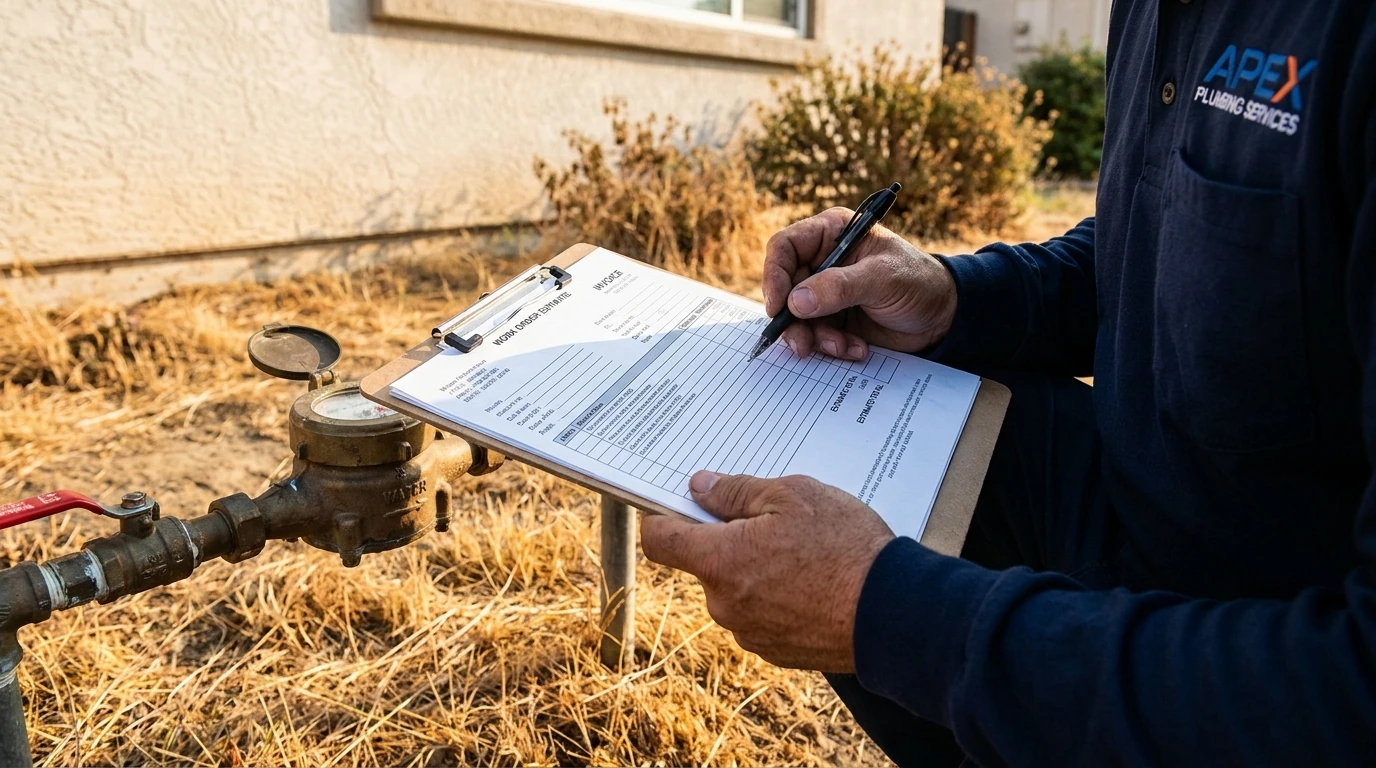
Most emergency plumbing invoices have four layers. Understanding each one prevents sticker shock when the paperwork arrives.
Layer 1: Call-out or trip fee. The flat dispatch charge to get a technician to your door. Typical range: $100-$300 after hours.
Layer 2: Diagnostic time. Once the technician arrives, they need to find the problem before they can fix it. Diagnostic time is usually billed at the after-hours hourly rate. A straightforward leak under a sink might take 15 minutes to diagnose. A hidden leak behind a wall or under a slab can take an hour or more, especially if leak detection equipment is involved.
Layer 3: Labor for the repair. This is the time spent actually fixing the problem, billed at the after-hours hourly rate. A simple supply line swap might take 30 minutes. Cutting out and replacing a burst copper pipe section in a wall can take 2-4 hours depending on access.
Layer 4: Parts and materials. Fittings, pipe sections, shutoff valves, and any other materials used on the job. Parts markups of 20-50% above wholesale are common in the trade. Ask if the quote includes parts or if they are billed separately.
Putting it together: a 2 a.m. burst pipe repair might look like a $200 call-out fee, plus 30 minutes of diagnostic time at $200/hr ($100), plus 2 hours of repair labor at $200/hr ($400), plus $80 in parts. Total: $780 before tax. That is a real-world range, not a worst case. More complex jobs cost more.
What actually counts as a plumbing emergency?
A plumbing emergency is any situation where waiting until morning will cause significantly more damage or create a safety hazard. The clearest examples are active water flow you cannot stop at a fixture shutoff, sewage backing up into living spaces, or a water heater that is actively leaking from the tank body.
Situations that feel urgent but can usually wait until business hours include a slow drain, a running toilet, low water pressure with no visible leak, and a dripping faucet. Calling an after-hours plumber for a slow drain will cost you two to three times what the same job costs on a Tuesday morning.
A useful test: can you stop the water at a shutoff valve (under the sink, behind the toilet, or at the main) and live without that fixture until morning? If yes, schedule it. If no, or if water is spreading, call now.
Does homeowners insurance cover an emergency plumber?
Homeowners insurance sometimes covers the damage caused by a sudden and accidental plumbing failure, but it rarely covers the plumber’s bill itself. The distinction matters.
Most standard HO-3 policies cover water damage from a sudden pipe burst, but exclude gradual leaks and maintenance-related failures. The policy typically pays to repair the structure (drywall, flooring, cabinetry) after the plumber stops the water. The plumbing repair itself is usually your out-of-pocket cost.
Call your insurer the same day if water has spread beyond the pipe. Document everything with photos before any cleanup begins. Ask your adjuster specifically whether your policy covers “sudden and accidental discharge” and whether a deductible applies. Our post Does Homeowners Insurance Cover Slab Leak Repair? goes deeper on how insurance interacts with plumbing claims.
If the water spread beyond the pipe and caused damage to walls, floors, or cabinets, our sister company ProRestoration Services handles the drying and rebuild side. One call does it all, so you are not coordinating two separate contractors while your floors are still wet.
How do you keep an emergency plumbing call from getting expensive?
Four things make the biggest difference in what you pay.
Know your shutoffs before an emergency happens. The faster you stop the water, the less damage accumulates and the simpler the repair. Walk your home now and locate the main shutoff, the water heater shutoff, and the angle stops under each sink and toilet.
Get a written quote before work starts. A reputable plumber will give you a scope and a price estimate before turning a wrench. If a technician refuses to quote and just starts working, that is a red flag. California’s Contractors State License Board recommends getting a written contract for any job over $500. You can verify a contractor’s license status at the CSLB license lookup before you approve work.
Ask about the call-out fee structure. Some companies waive the trip fee if you proceed with the repair. Others apply it regardless. Knowing this upfront helps you compare quotes accurately.
Describe the problem accurately when you call. The more detail you give the dispatcher (water is actively spraying vs. a slow drip, copper pipe vs. under-sink supply line, accessible vs. inside a wall), the more accurate the initial estimate. Vague descriptions lead to underestimates that balloon on-site.
What should you check before hiring any emergency plumber?
When water is actively running, it is tempting to hire whoever answers the phone first. Take 60 seconds to verify two things.
First, check that the contractor holds a valid California plumbing license. In California, plumbing contractors must hold a C-36 license issued by the Contractors State License Board. You can verify any license number in seconds at cslb.ca.gov. An unlicensed contractor doing plumbing work in California is operating illegally, and any warranty or recourse you have is limited.
Second, ask whether they carry general liability insurance and workers’ compensation. If a technician is injured on your property and the company has no workers’ comp, you may be exposed. Ask for a certificate of insurance before work begins.
Those two checks take less time than it takes for the technician to unload the truck.
All Pro Plumbing Heating and Air dispatches 24 hours a day, 7 days a week. If you have an active leak or a burst pipe and need a technician now, call (661) 863-9242. For non-emergency scheduling or a written quote on burst pipe repair or leak detection, use our online request form.
About All Pro Plumbing Heating and Air
All Pro Plumbing Heating and Air is a 24/7 plumbing, heating, and air conditioning service provider based in Bakersfield, CA, serving Kern County and surrounding communities including Oildale, Rosedale, Shafter, Delano, and Taft. Their technicians handle emergency plumbing, burst pipe repair, leak detection, slab leak repair, drain cleaning, water heaters, gas lines, and full HVAC service. For contractor license verification in California, visit the CSLB at cslb.ca.gov.